
Observing what happens when time demands holding: standing at the exact point of passage, in the moment just before forms begin to change.
When the rhythm shifts, postures emerge
There are times of the year when the rhythm changes.
And some things become more visible.
The holidays are one of those moments. Roles come into view. Expectations take shape. Gestures we move through all year without noticing become repeated, recognizable, almost necessary.
Positions grow more explicit, forms of holding are activated, distances either shorten or stiffen.
Time itself becomes amplified.
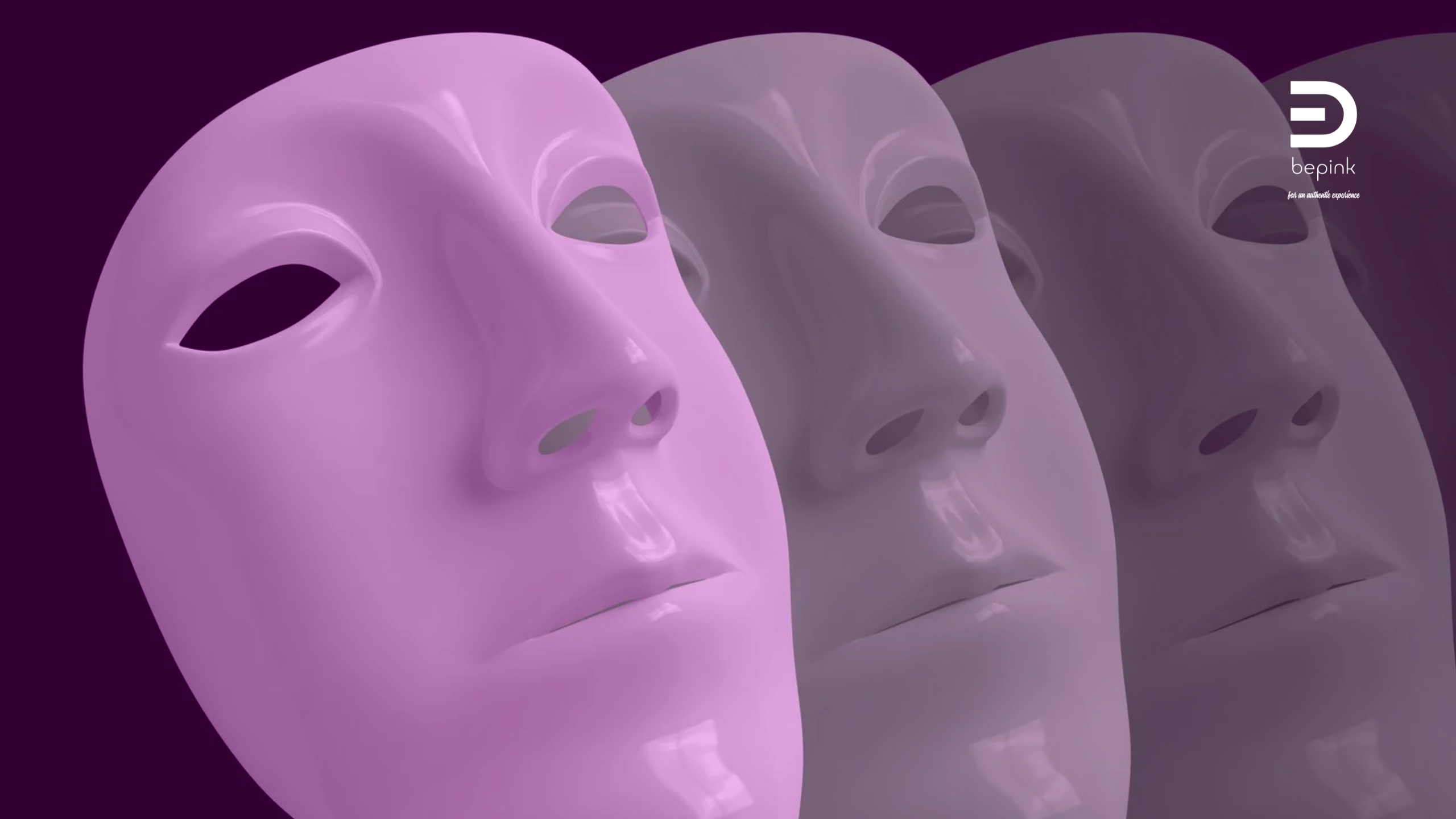
The Mask as a transitional device
This is where the Mask comes into play. Not as deception. Not as pretense. But as a transitional device.
The Mask marks a threshold. It allows us to enter a space that is neither neutral nor ordinary — a space dense with memory, relationships, and inheritance. A time that asks to be given form.
Wearing it does not mean hiding. It means holding the intensity.
Sometimes what remains is not what we show, but the way we have inhabited the crossing.

Containing intensity: roles, holding, transformation
During the holidays, this is exactly what we inhabit: a dense field in which we perform versions of reality that are stable enough to allow us to be together.
Roles that hold. Postures that can hold the load.
This is what the Mask is for. To contain. To allow contact without collapse.
But every mask is also a test. Because it amplifies whatever it touches.
If it doesn’t fit, the stage gives way. If it is chosen with care, it protects and lets things flow.
Every transformation passes through here: through a time in which something must be held before it can be changed.
The Mask is a temporary container.
Observing what happens: beyond the mask
Choosing a mask carefully does not mean fixing oneself in a role. It means recognizing that forms are many. That none of them fully coincide with who we are. That they can be inhabited — and then released.
The gesture is not removal.
The gesture is observation.
Because what remains, after the passage, is not the mask.
It is a gaze that knows how to stay.